ATOMIC STRUCTURE
Protons, neutrons, electrons — and how the arrangement of these particles explains the entire periodic table.
Atomic Structure
Everything in chemistry — every bond, every reaction, every property of every material — comes down to how a small number of subatomic particles are arranged inside atoms. This chapter builds that picture from scratch.
Chapter 1 — Inside the Atom
Key Idea
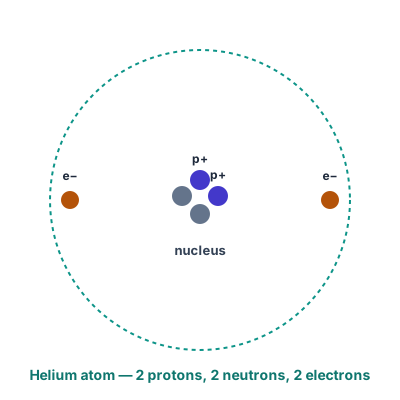
An atom is the smallest particle of an element that still has the chemical properties of that element. Every atom is built from three subatomic particles: protons, neutrons, and electrons.
| Particle | Relative mass | Relative charge | Location |
|---|---|---|---|
| Proton | 1 | +1 | Nucleus |
| Neutron | 1 | 0 | Nucleus |
| Electron | Shells around the nucleus |
The nucleus sits at the centre of the atom and contains the protons and neutrons (together called nucleons). It holds almost all of the atom's mass but takes up almost none of its volume — if an atom were the size of a football stadium, the nucleus would be about the size of a pea sitting on the centre spot.
The electrons occupy the much larger space around the nucleus, arranged in shells (energy levels). Because a proton's charge () exactly cancels an electron's charge (), a neutral atom always has equal numbers of protons and electrons.
Worked Example
A neutral atom has 6 protons. How many electrons does it have?
Since the atom is neutral, the number of electrons must equal the number of protons: 6 electrons.
Chapter 2 — Atomic Number and Mass Number
Key Idea
Two numbers, usually written to the left of an element's symbol, tell you exactly what an atom is made of.
- Atomic number () — the number of protons in the nucleus. This is what defines the element: every atom with 8 protons is an oxygen atom, and only oxygen atoms have 8 protons. The atomic number also equals the number of electrons in a neutral atom.
- Mass number () — the total number of protons and neutrons in the nucleus (the nucleons). Electrons are so light they're not counted.
So the number of neutrons in an atom is found by:
Worked Example
Sodium is written as . Find the number of protons, neutrons, and electrons.
- Protons = atomic number = 11
- Neutrons = mass number − atomic number =
- Electrons (neutral atom) = protons = 11
Chapter 3 — Isotopes
Key Idea
Isotopes are atoms of the same element (same number of protons) with different numbers of neutrons — and therefore different mass numbers.
Because isotopes have identical proton and electron arrangements, they have identical chemical properties. But because they have different numbers of neutrons, they have different physical properties, most obviously different masses, and some isotopes are radioactive while others are stable.
Example — the isotopes of chlorine
| Isotope | Nuclide notation | Protons | Neutrons | Mass number |
|---|---|---|---|---|
| Chlorine-35 | 17 | 18 | 35 | |
| Chlorine-37 | 17 | 20 | 37 |
Naturally occurring chlorine is a mixture of these two isotopes — roughly 75% chlorine-35 and 25% chlorine-37 — which is why the relative atomic mass of chlorine on the periodic table (35.5) isn't a whole number. It's the weighted average of the isotope masses:
Key Takeaway
Relative atomic mass is a weighted average across all naturally occurring isotopes of an element — that's the only reason it isn't always a whole number.
Chapter 4 — Electron Configuration
Key Idea
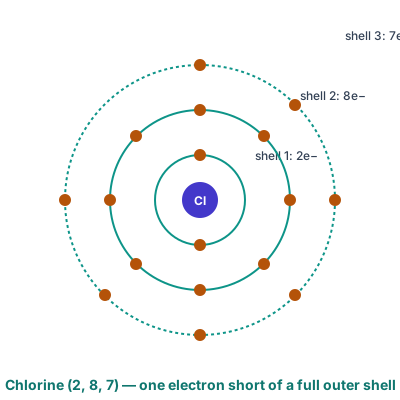
Electrons don't crowd randomly around the nucleus — they fill shells (numbered 1, 2, 3… outward from the nucleus) in a predictable order, and each shell has a maximum capacity:
- Shell 1 (closest to the nucleus): up to 2 electrons
- Shell 2: up to 8 electrons
- Shell 3: up to 8 electrons (for the first 20 elements)
Electrons fill the lowest-energy shell available first (closest to the nucleus) before starting the next shell outward.
Worked Example
Write the electron configuration of chlorine (atomic number 17).
17 electrons to place: fill shell 1 (2), then shell 2 (8), leaving for shell 3.
Why this matters
The electrons in the outermost shell — the valence electrons — are what determine an element's chemical behaviour, including how it bonds with other atoms. Chlorine's 7 outer electrons are one short of a full shell of 8, which is exactly why chlorine is so reactive: it readily gains one electron to complete its outer shell.
Chapter 5 — Ions
Key Idea
Atoms are neutral only while they have equal numbers of protons and electrons. When an atom gains or loses electrons, it becomes charged — this charged particle is called an ion.
- Losing electrons → fewer negative charges than positive → a positive ion (cation)
- Gaining electrons → more negative charges than positive → a negative ion (anion)
Atoms tend to gain or lose electrons to reach a full outer shell, which is the most stable arrangement — the same reasoning explains chlorine's reactivity above.
Worked Example
A sodium atom (2, 8, 1) loses its single outer electron to form a sodium ion. What is the charge, and what is the new electron configuration?
Losing 1 electron from a neutral atom (11 protons, 11 electrons) leaves 11 protons and 10 electrons: charge , written . New configuration: 2, 8 — a full outer shell.
Key Takeaway
Protons never change during ion formation — only electrons move. That's the difference between forming an ion (a chemical change) and changing an isotope (a nuclear change, which alters the number of neutrons instead).
Chapter 6 — Relative Atomic Mass Explained
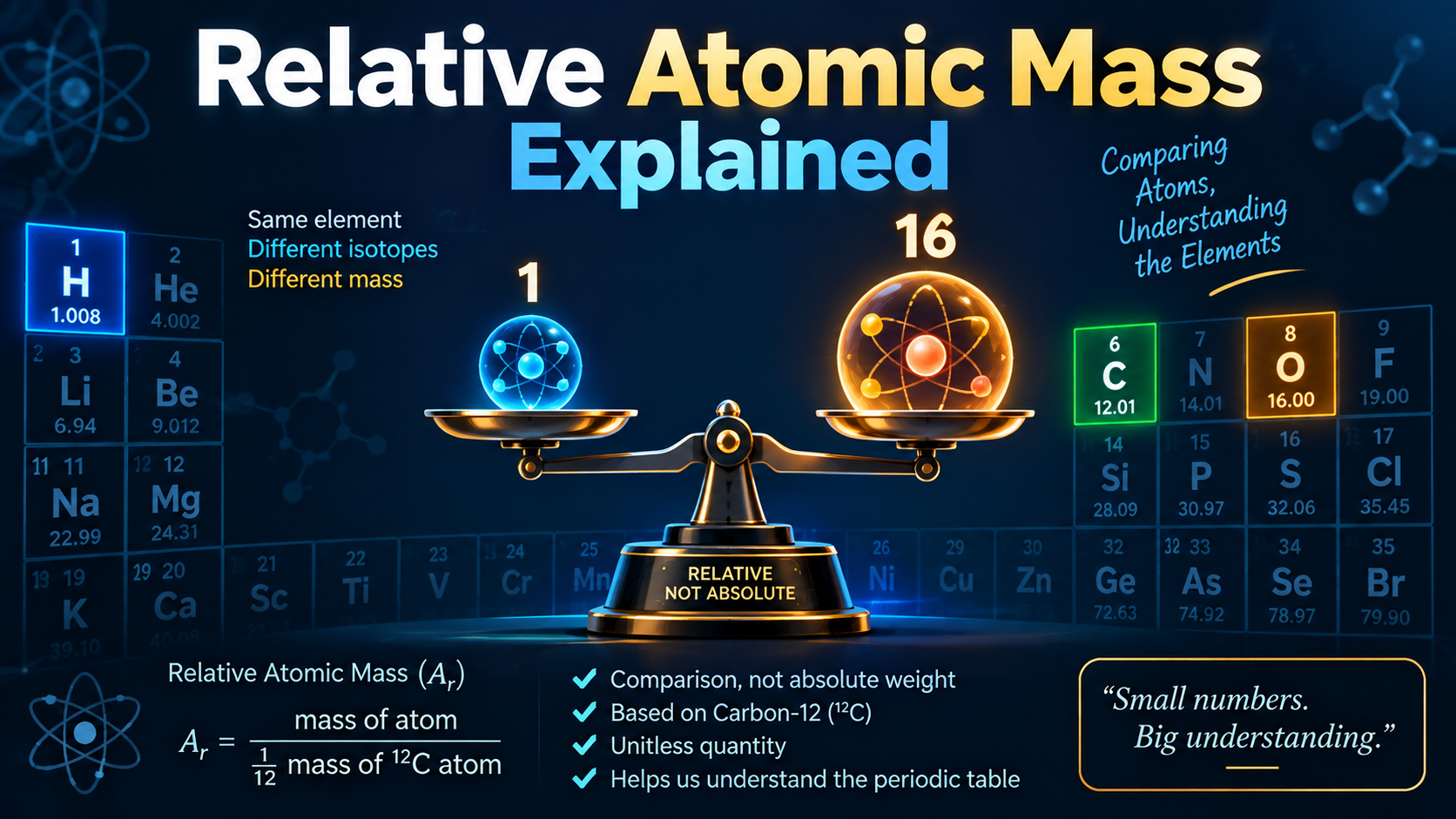
Why chemists compare instead of weigh — the simple truth behind the periodic table's numbers.
Look at any periodic table and you'll see a small number sitting under each element's symbol — 1 for hydrogen, 12 for carbon, 16 for oxygen, and so on. Most students are told to memorize these as "atomic mass" without ever being told what's actually being measured, or why the numbers work the way they do. This chapter clears that up from the ground up.
The Core Idea: These Numbers Are Comparisons, Not Weights
The first thing to unlearn is the assumption that the number under oxygen (16) means "one oxygen atom weighs 16 grams" or any other direct unit of weight. It doesn't. That number means: an oxygen atom weighs about 16 times as much as a hydrogen atom.
That's the entire idea behind the term relative atomic mass — "relative" because every number on the table is a comparison relative to something else, not a standalone weight measured on its own.
Why Compare Instead of Just Weighing Atoms Directly?
Early chemists working out these numbers, in the 1800s and earlier, had no tool capable of placing a single atom on a scale — atoms are far too small, and the instruments needed to weigh something that tiny simply didn't exist yet. What they could do, using ordinary lab equipment, was react measured amounts of one element with measured amounts of another and see how much of each combined.
For example, if you carefully measure how much hydrogen gas reacts with how much oxygen gas to form water, and you know the ratio in which their atoms combine (2 hydrogen atoms for every 1 oxygen atom, since water is ), you can work backward to figure out how the weights of individual atoms compare to each other — without ever isolating or weighing a single atom on its own.
This is the same style of reasoning you'd use in a detective case: you don't see the atom directly, but you use the measurable clues left behind (how much mass reacted with how much) to work out a relationship between things you can't observe directly.
Choosing a Reference Point: Why Carbon-12?
Since these numbers only make sense as comparisons, chemists needed to pick one element as a fixed reference point — like choosing to measure everyone's height "relative to" one specific person, and giving that person a round number like 100.
Today, that reference is carbon-12, a specific isotope of carbon, which is officially assigned a value of exactly 12. Every other element's atomic mass on the periodic table is really saying: "this atom weighs this many times more (or less) than 1/12th the weight of a carbon-12 atom."
So when you see oxygen listed as 16, that means an oxygen atom weighs about times as much as a carbon-12 atom — or equivalently, 16 times as much as 1/12th of a carbon-12 atom.
Historically, hydrogen was the original reference point chemists used (since it's the lightest element, making a convenient "unit"), before the field settled on carbon-12 as the modern standard for reasons of measurement precision and consistency. The scale changed reference points over time, but the underlying logic — everything measured relative to one chosen anchor — stayed the same.
Do We Actually Know an Atom's Real Weight?
This is a common and reasonable point of confusion, so it's worth stating clearly: it's not that absolute atomic weights are unknown or unmeasurable. Today, scientists can and do measure the real, absolute mass of individual atoms very precisely, using instruments like mass spectrometers. A single hydrogen atom, for instance, has a real measured mass of about grams — an almost unimaginably tiny but perfectly real, known number.
So why do chemists still use the relative scale (1, 12, 16, 32…) instead of just switching to these absolute gram values everywhere? Convenience, plus history. Working with numbers like 1, 12, and 16 is far easier in everyday chemistry calculations than constantly writing out values like grams. And the relative scale is how the entire system was originally built, atom-ratio by atom-ratio, back when absolute masses couldn't be measured at all — the practice simply stuck because it works well and every chemistry textbook, tool, and calculation in existence is built around it.
Putting It Together With a Mole
This connects directly to the mole. Once you know an element's relative atomic mass (say, 16 for oxygen), you can say: "one mole of oxygen atoms weighs 16 grams." The relative number on the periodic table, followed by the unit "grams," directly gives you the real-world mass of one mole of that element — this is called its molar mass. That's the practical payoff of the whole system: a simple comparison number, built from reaction-ratio measurements centuries ago, still tells you exactly how many grams to weigh out today.
Key Takeaway
The numbers on the periodic table aren't direct weights — they're relative atomic masses, meaning each one tells you how many times heavier (or lighter) an atom is compared to a fixed reference point, today set as carbon-12 = 12. Early chemists built this system not by weighing individual atoms directly (which was impossible with the tools they had), but by measuring how much of one element reacted with how much of another, then working out the weight ratios between atoms from those reaction measurements. Modern instruments can now measure the real, absolute mass of individual atoms directly — so the relative scale isn't used because absolute values are unknown, but because it's simpler to work with and it's the foundation the entire field of chemistry, including the concept of molar mass, has been built on ever since.
Chapter 7 — Avogadro's Law and Molar Volume
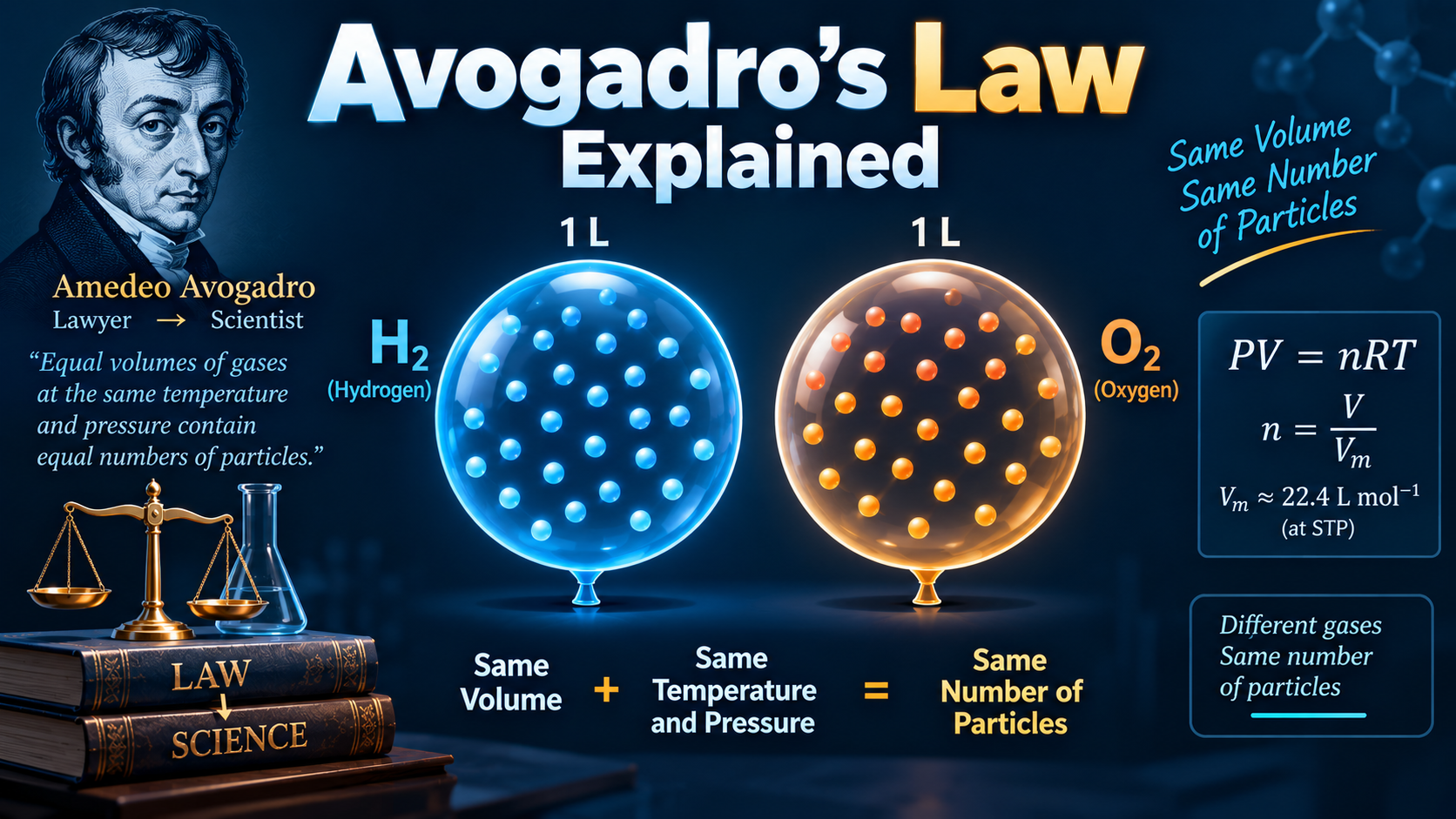
Why equal volumes of gas have equal numbers of particles.
If you've ever stared at a chemistry textbook line like "equal volumes of gases contain equal numbers of molecules" and thought, "wait, why would that be true?" — you're not alone. This idea, known as Avogadro's Law, trips up more students than almost anything else in early chemistry. This chapter breaks it down completely, from the ground up.
Who Was Avogadro, and Why Does a Lawyer Show Up in a Chemistry Book?
Amedeo Avogadro, the Italian scientist this law is named after, didn't start out as a scientist at all. He trained and worked as a lawyer in his 20s, before teaching himself physics and mathematics and eventually switching careers to become a physics professor.
That legal background matters more than it seems. Avogadro never ran the lab experiments behind his own law — instead, a French chemist named Joseph Gay-Lussac had already collected the experimental data. Avogadro's contribution was building the single best explanation that made sense of that data — exactly the skill a lawyer uses to build a tight argument from existing evidence, just aimed at gas particles instead of a courtroom case.
The Clue That Started It All
Gay-Lussac measured gas volumes before and after chemical reactions, and kept finding the same pattern: gases always combined in clean, whole-number volume ratios. For example:
Never anything messy like 2.3 liters combining with 1.1 liters. Always simple ratios like 2:1:2, or 1:1:1, or 3:1:2. This showed up over and over, across completely different gases. That consistency was the mystery Avogadro set out to explain.
The order of discovery matters here. The volume-ratio data came first, measured in the lab. The "equal particles" idea was the explanation invented afterward, specifically to make sense of that data — not something proven independently and then confirmed by the ratios. Avogadro looked at the pattern and asked: what has to be true for these ratios to always come out as clean whole numbers?
There's one detail in the data that's easy to skip past but is actually essential: Gay-Lussac's measurements were always taken with the gases at the same temperature and pressure. That condition isn't a minor footnote — it's load-bearing. If you compared a hot, high-pressure gas to a cold, low-pressure one, the ratios wouldn't come out clean at all, because the packing of particles would differ for reasons that have nothing to do with the chemistry. Fixing temperature and pressure is what makes the volume data trustworthy evidence in the first place.
Avogadro's Idea, in One Sentence
Avogadro proposed: equal volumes of any gas, at the same temperature and pressure, contain the same number of particles — no matter what the gas is.
Picture two identical balloons, both blown up to the exact same size. One is filled with hydrogen, the other with oxygen. Avogadro's law says: those two balloons contain the exact same number of gas particles, even though hydrogen and oxygen are completely different substances.
Why Would That Be True? (The Parking Lot Picture)
Here's the part that seems to break intuition: shouldn't a "bigger" gas particle take up more room, meaning fewer of them would fit in the same space?
Think about parking vehicles in a huge, mostly empty parking lot. Park motorcycles across the whole lot, spaced 10 feet apart. Now clear the lot and park trucks instead, also spaced 10 feet apart. You'll fit roughly the same number of vehicles either way — because what decided the count wasn't the size of the vehicle. It was the spacing rule you applied.
Gas particles behave the same way. In a gas, particles are flying around wildly, mostly far apart, with huge empty gaps between them — like a handful of ping pong balls bouncing around inside an entire empty room. The balls themselves take up almost none of the room's actual space; it's nearly all empty air between them. So the particle's own size barely matters. What controls how many particles fit in a given volume is how much "elbow room" each one needs to fly around in — and that elbow-room requirement is set by temperature and pressure, not by what the gas is made of. Keep temperature and pressure the same, and you get the same particle count, regardless of the gas.
How Could He Know This Without Ever Seeing an Atom?
This is worth addressing directly, because it's a fair question. Avogadro didn't "know" this the way you know something you've directly observed. He proposed it as a hypothesis — the single best explanation that accounted for all of Gay-Lussac's clean-ratio data.
Think of it like the difference between a photographer and a detective. A photographer captures the event directly. A detective never sees the event — only the clues left behind — and works out the one explanation that fits every clue. Avogadro never saw a gas particle. But he reasoned: if equal volumes contain equal particle counts, then the clean whole-number ratios stop being a mysterious coincidence and become something that's guaranteed to happen every time. One simple assumption explained dozens of separately observed results — which is exactly what makes a hypothesis strong.
It's also worth knowing this idea was mostly ignored for about 50 years after Avogadro proposed it in 1811. Atoms themselves were still unproven at the time, so there was no way to confirm his hypothesis directly. It only gained wide acceptance decades later, once another chemist, Stanislao Cannizzaro, showed how well it explained other atomic weight data.
A Common Misunderstanding: Does 2 + 1 Always Equal 3?
Looking at "2 liters of hydrogen + 1 liter of oxygen → 2 liters of water," it's natural to expect the volumes to just add up (2 + 1 = 3 liters of product). But that's not the rule — and this is one of the most important corrections to make early on.
What's conserved in a reaction is atoms, not volume. Volume is simply a reflection of however many separate molecules exist on each side — it isn't forced to add up on its own.
Let's count atoms directly, using the reaction:
- Left side: 2 units of = 4 hydrogen atoms. 1 unit of = 2 oxygen atoms.
- Right side: those same 4 hydrogen atoms and 2 oxygen atoms need to be packaged into water molecules. Each water molecule () uses 2 hydrogen atoms and 1 oxygen atom. So 4 H atoms + 2 O atoms build exactly 2 complete water molecules — no more, no less.
It's like having exactly 4 wheels and 2 car-bodies: you can build exactly 2 complete toy cars, not 3, no matter how much you'd like to stretch the material further.
Since "2 units" of water corresponds to 2 liters (using the equal-particles rule), the final gas volume is 2 liters — smaller than the 3 liters you started with. The volume shrank because 3 separate starting molecules () recombined into only 2 separate product molecules (). Fewer total molecules on the product side means fewer liters, even though every single atom is still accounted for.
Key Takeaway
Balance reactions by counting atoms and molecules — never by adding up volumes directly.
A Full Worked Example: Volume Ratio → Molecule Ratio → Balanced Equation
Here's a second example that shows the whole chain working end to end, step by step. Say you measure this reaction in the lab, keeping temperature and pressure fixed throughout:
Your measured volumes come out as:
That's a clean ratio of 1 : 3 : 2 — real, Gay-Lussac-style lab data.
Now apply Avogadro's assumption. Since we're holding temperature and pressure fixed, say 1 liter of any gas here holds some fixed number of particles — call it (the actual value of doesn't matter for this to work). Then:
- 1 liter of nitrogen = nitrogen molecules
- 3 liters of hydrogen = hydrogen molecules
- 2 liters of ammonia = ammonia molecules
So at the particle level, the reaction becomes:
Divide through by (it's just a scaling number):
This matches the real, balanced chemical equation exactly. Checking the atoms confirms it: 1 molecule has 2 nitrogen atoms; 2 molecules also need 2 nitrogen atoms total. 3 molecules have 6 hydrogen atoms; 2 molecules need 6 hydrogen atoms total (3 each). Both sides balance perfectly.
The key point this example proves: we never needed to know what actually was. The volume ratio alone (1:3:2), combined with the equal-particles assumption, correctly predicted the molecule ratio (1:3:2) — which then checked out against real atom-counting. That's exactly the kind of result that made chemists trust the assumption: a simple rule, applied over and over to completely different gases and reactions, kept spitting out chemically sensible, atom-balanced answers.
So Is There a "Proportional Law" Making This Happen?
It's tempting to think some separate "law of proportions" is sitting underneath all this, forcing the ratios to line up at every level. But that's not quite right, and it's worth being precise here.
Avogadro's assumption is itself what forces the proportionality — it isn't a separate rule layered on top. Once you assume "1 liter of gas = particles, for any gas, at fixed temperature and pressure," multiplying every volume by that same fixed automatically keeps the ratio identical whether you're counting in liters, in molecules, or in atoms. The proportionality isn't an extra ingredient — it's a direct mathematical consequence of the one core assumption.
There is, however, a genuinely separate and real law that also involves proportions, worth not confusing with this one: the Law of Definite Proportions, from the chemist John Dalton (developed slightly before Avogadro's work). It states that a given chemical compound always contains its elements in the same fixed mass ratio, no matter how much of it you make — water, for instance, is always 1 gram of hydrogen for every 8 grams of oxygen, whether you're making a teaspoon or a swimming pool of it.
The two ideas sound similar because both involve the word "proportion," but they answer different questions:
- Avogadro's Law — about volume and particle count staying proportional across different gases, at fixed temperature and pressure.
- Dalton's Law of Definite Proportions — about mass ratios staying fixed within one specific compound, regardless of quantity made.
Keeping these separate matters, because reaching for "it's a proportional law" as a catch-all explanation blurs two distinct ideas that are actually doing different jobs in chemistry.
What Is "Molar Volume," and Where Does 22.4 Come From?
Once you accept that equal volumes of gas contain equal numbers of particles, a natural next question appears: how much space does exactly one mole of gas ( particles) take up?
Chemists measured this directly, and the number depends on the temperature and pressure at the time of measurement, since gases expand when heated and compress under pressure:
- 22.4 litres per mole — at STP (Standard Temperature and Pressure: 0°C and 1 atmosphere). This is the classic number found in most textbooks.
- ~24 to 24.8 litres per mole — at room temperature conditions (around 25°C, sometimes called SATP). Since this is warmer than STP, the gas particles have more energy and spread into a slightly larger space, so the volume per mole is a bit higher.
So there isn't one single universal number — there's a specific volume-per-mole for a specific set of conditions. Change the temperature or pressure, and the number shifts accordingly.
This gives a direct shortcut between the volume of a gas and the number of moles it contains, without needing to know its molar mass in grams:
Worked Example
Suppose you have 44.8 litres of a gas at STP. How many moles is that?
No need to know what the gas even is — Avogadro's Law guarantees the volume-to-mole relationship holds for any gas under the same conditions.
Key Takeaway
Avogadro, a lawyer-turned-scientist, looked at Gay-Lussac's lab data showing gases always combine in clean whole-number volume ratios under fixed temperature and pressure, and proposed the simplest explanation: equal volumes of any gas, under those same fixed conditions, contain equal numbers of particles. That single assumption is what forces volume ratios, molecule ratios, and atom ratios to all stay proportional to each other — it isn't a separate "proportional law," just a direct consequence of the one core idea. From Avogadro's Law comes molar volume: the fixed volume that one mole of any gas occupies under specific conditions (22.4 L/mol at STP, or roughly 24 L/mol at room temperature), which lets you convert directly between the volume of a gas and the number of moles it contains.
Chapter 8 — The Octet Rule, Shells, and Sub-Levels
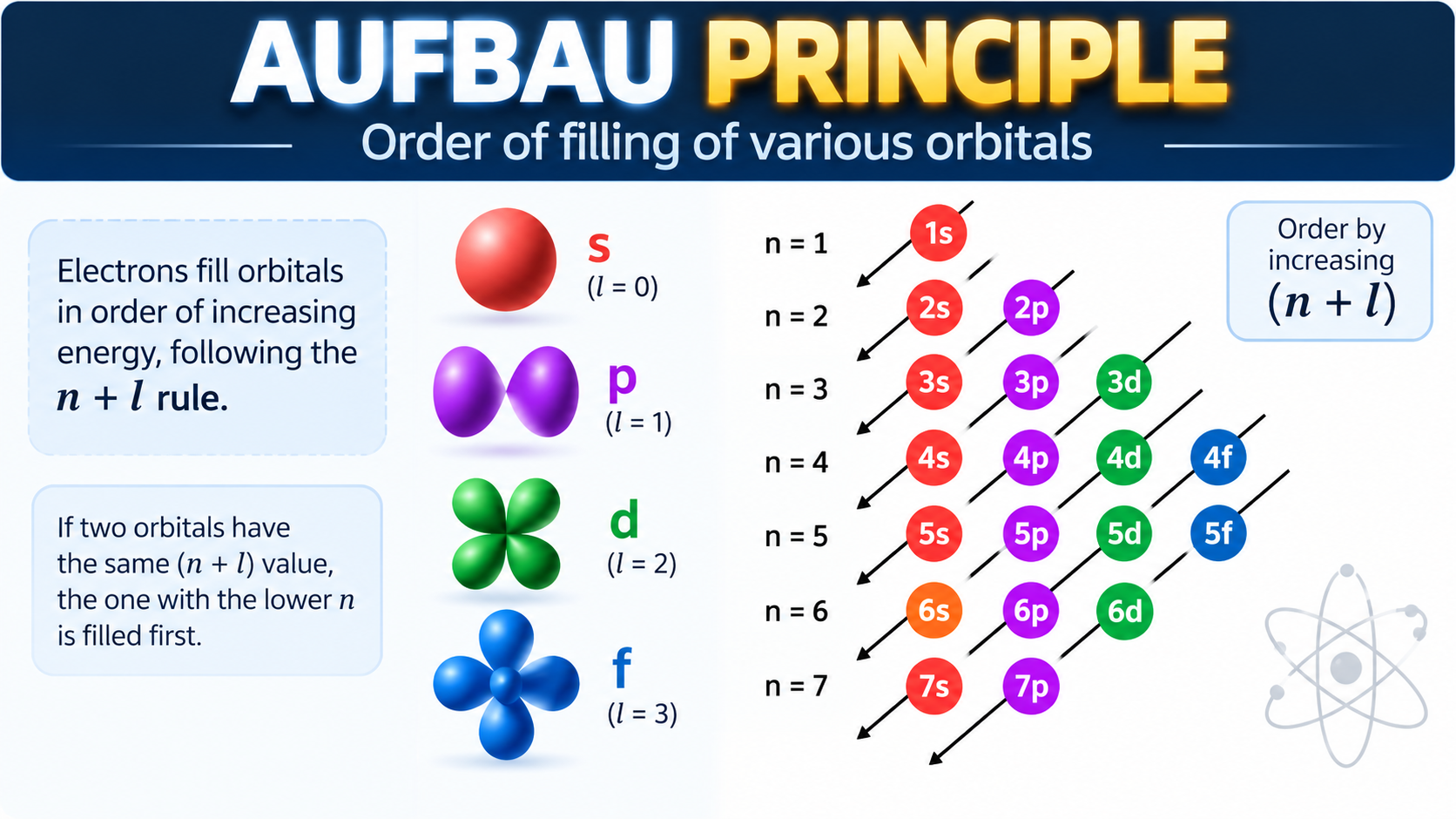
Why "8 electrons" isn't the whole story.
If you've ever been taught the octet rule as "atoms want 8 electrons in their outer shell" and left wondering why 8, why some shells seem to break that rule, and what "shell" even really means compared to "orbit" or "orbital" — this chapter builds it up from the simplest picture to the real mechanism underneath.
What Is a Shell (or Orbit)?
Electrons don't float randomly around the nucleus — they exist in layers, called shells or energy levels, like layers of an onion. The shell closest to the nucleus is shell 1, then shell 2 further out, then shell 3, and so on. Each shell has a maximum number of electrons it can hold — like floors of a building, each with a limited number of rooms.
"Shell" and "orbit" are the same idea, just from the older, simplified Bohr model of the atom, where electrons were imagined circling the nucleus along fixed circular paths (orbits), each corresponding to a distinct energy level (shell). In basic chemistry, these two words are used interchangeably.
"Orbital" is a different, more precise term. In the real, modern quantum-mechanical model, electrons don't travel along neat circular paths — each electron instead exists in a fuzzy, cloud-like region of probable locations, called an orbital. Each shell is made up of one or more orbitals, grouped into sub-levels. You only need this distinction once you go deeper than basic bonding behavior — for everyday chemistry, "shell" and "orbit" can be treated as the same thing.
The Maximum Capacity Formula:
Each shell's maximum electron capacity follows a simple formula:
- Shell 1 ():
- Shell 2 ():
- Shell 3 ():
- Shell 4 ():
The Octet Rule: A Stability Rule, Not a Capacity Rule
Atoms are more stable — calmer, less reactive — when their outermost shell is completely full. For shell 1, that means 2 electrons. For shell 2 and shell 3 (when acting as the outermost shell), that means 8 electrons. Since most common early elements (carbon, nitrogen, oxygen, sodium, chlorine) deal with shell 2 or 3 as their outer boundary, the number 8 comes up constantly — hence the name octet rule ("octet" = a group of 8).
An atom with an incomplete outer shell is chemically reactive — it wants to bond with another atom to complete that shell, either by:
- Sharing electrons (a covalent bond), or
- Giving away or taking electrons entirely (an ionic bond)
This is why atoms bond at all — to reach a stable, complete outer shell.
The Apparent Contradiction: Shell 3 Can Hold 18, So Why Does the Octet Rule Say 8?
This is where most students get stuck, and it's worth resolving precisely. The capacity ( for shell 3) and the octet target () are answering two different questions:
- → the total physical capacity of shell 3, relevant once it's no longer the outermost shell.
- Octet rule () → a stability target, applying only to whichever shell is currently outermost — regardless of that shell's absolute maximum capacity.
For elements up to around calcium (atomic number 20), when shell 3 is the outermost shell, it only fills to 8 electrons before shell 4 starts being used instead. The rest of shell 3's capacity (up to 18) only gets used later, once shell 3 becomes an inner shell in heavier elements.
Key Takeaway
The octet rule only ever applies to whichever shell is currently outermost — never to a shell's full capacity.
Why Does Shell 3 "Stop" at 8? Sub-Levels and Energy Ordering
The real mechanism: each shell isn't one single unit — it's divided into sub-levels, named , , , , each with its own fixed capacity:
- : up to 2 electrons
- : up to 6 electrons
- : up to 10 electrons
- : up to 14 electrons
Shell number contains types of sub-levels, starting from :
- Shell 1: only → (matches )
- Shell 2: → (matches )
- Shell 3: → (matches )
- Shell 4: → (matches )
Electrons fill the lowest-energy sub-level available first — and energy doesn't rise in tidy shell order. Specifically, shell 3's sub-level sits at a higher energy than shell 4's sub-level. So once shell 3's and sub-levels are full ( electrons), the next electron skips ahead into shell 4's sub-level rather than shell 3's sub-level — which is exactly why shell 3 "stops at 8" while acting as an outer shell. Shell 3's sub-level only fills in later, once shell 4 has already started, in heavier elements.
The true energy fill order (the Aufbau principle, "building-up principle") is:
Worked Example — Chlorine (17 electrons)
Filling in true energy order: (). Grouped by shell: Shell 1 = 2, Shell 2 = 8, Shell 3 = → arrangement 2, 8, 7. Chlorine's outer shell (shell 3) has 7 electrons — 1 short of the octet's 8 — making it highly reactive, eager to gain 1 electron.
Worked Example — Iron (26 electrons), Past Atomic Number 20
Filling in true energy order: (). Grouped by shell: Shell 1 = 2, Shell 2 = 8, Shell 3 = , Shell 4 = 2 → arrangement 2, 8, 14, 2.
Notice shell 3 now holds 14 electrons — more than 8, because it's no longer the outermost shell (shell 4 is). Once a later element pushes past shell 3 and starts filling shell 4, shell 3 quietly continues filling toward its true 18-capacity in the background. This is exactly why elements past atomic number 20 — the transition metals — start behaving differently from the simple patterns seen in sodium, chlorine, oxygen, and carbon.
Full Configuration Table: Elements Past Atomic Numbers 20, 30, 40, 50, 60
Here's the table with a Shells (filled electrons) column added, showing how many electrons sit in each shell, grouped from the full sub-level configuration.
| Atomic # | Element | Electron Configuration | Shells (filled electrons) | Last Sub-level Filled | Next Sub-level Expected |
|---|---|---|---|---|---|
| 21 | Scandium (Sc) | Shell 1: 2, Shell 2: 8, Shell 3: 9, Shell 4: 2 | — 1 of 10 electrons | continues filling (capacity 10); after that, (capacity 6) | |
| 31 | Gallium (Ga) | Shell 1: 2, Shell 2: 8, Shell 3: 18, Shell 4: 3 | — 1 of 6 electrons | continues filling (capacity 6); after that, (capacity 2) | |
| 41 | Niobium (Nb) | Shell 1: 2, Shell 2: 8, Shell 3: 18, Shell 4: 11, Shell 5: 2 | — 3 of 10 electrons | continues filling (capacity 10); after that, (capacity 6) | |
| 51 | Antimony (Sb) | Shell 1: 2, Shell 2: 8, Shell 3: 18, Shell 4: 18, Shell 5: 5 | — 3 of 6 electrons | continues filling (capacity 6); after that, (capacity 2) | |
| 61 | Promethium (Pm) | Shell 1: 2, Shell 2: 8, Shell 3: 18, Shell 4: 23, Shell 5: 8, Shell 6: 2 | — 5 of 14 electrons | continues filling (capacity 14); after that, (capacity 10) |
How the shell totals are built: each shell's number is the sum of its own sub-levels. For example, niobium's shell 4 = (note: the "4" in "" refers to shell 4, not shell 5 — a detail worth double-checking carefully, since it's an easy place to slip up). Shell 5 for niobium is just .
Worth flagging honestly: real-world niobium is actually a known exception to the predicted pattern above — its true measured configuration is instead of , due to a subtle extra-stability effect when a sub-level gets close to half-full. Several such exceptions exist among the transition metals; the Aufbau order predicts the correct configuration for the large majority of elements, with a handful of memorized special cases like this one.
Key Takeaway
Shells and orbits are the same idea — energy layers around the nucleus, each with a theoretical maximum capacity given by . Orbitals are the more precise, modern sub-regions within a shell. The octet rule doesn't care about a shell's full capacity — it only asks whether the current outermost shell has reached a stable 8 (or 2, for shell 1). Shells are actually built from sub-levels (, , , ), each with its own capacity, and electrons fill these in strict energy order (the Aufbau principle) — which is why shell 3 appears to "stop" at 8 while it's the outer shell (its sub-level is higher energy than shell 4's sub-level), only filling the rest of its capacity later, once it becomes an inner shell in heavier elements like iron, scandium, and beyond.
Material — Claude: https://claude.ai/chat/e58d8429-d03f-4315-b39c-bc77de06ac00
Slide 1 of 5
Three Subatomic Particles
- Proton: charge +1, mass 1, in the nucleus
- Neutron: charge 0, mass 1, in the nucleus
- Electron: charge -1, mass ~0, in shells around the nucleus
A neutral atom has equal numbers of protons and electrons.
Physics — Mass Spectrometry and Nuclear Physics
A mass spectrometer separates isotopes by firing ionised atoms through a magnetic field. Because heavier ions curve less sharply than lighter ones for the same speed and charge, the instrument sorts atoms purely by mass-to-charge ratio — a direct physical measurement of the isotope masses introduced in Chapter 3.
Atomic structure is also the foundation of nuclear physics: radioactive decay happens when an unstable nucleus (an isotope with the "wrong" ratio of protons to neutrons) emits particles or energy to become more stable. Alpha decay reduces both the atomic number and mass number; beta decay changes a neutron into a proton (or vice versa) without changing the mass number at all.
Biology — Radioactive Isotopes as Tracers
Because isotopes of the same element behave identically in chemical reactions, biologists can substitute a radioactive isotope for its stable counterpart and track it through a living system without changing how it behaves chemically.
- Carbon-14 dating uses the known decay rate of this carbon isotope to estimate the age of once-living material.
- Iodine-131 is used medically to image and treat the thyroid gland, which naturally absorbs iodine to make hormones.
In both cases, it's the fact that isotopes share identical electron configurations — and therefore identical chemistry — that lets the radioactive form stand in for the stable one.
Mathematics — Weighted Averages
Calculating relative atomic mass from isotope abundances (Chapter 3) is a direct application of a weighted average:
This is the same mathematical idea used to calculate a weighted grade average from several assessments of different weightings, or an expected value in probability — a quantity where each possible outcome contributes in proportion to how often it occurs, rather than every outcome counting equally.
Environmental Science — Isotopes as Environmental Clocks
Ratios of naturally occurring isotopes act as a record of environmental conditions:
- The ratio of oxygen-18 to oxygen-16 trapped in ancient ice cores changes with past ocean temperatures, letting scientists reconstruct historical climate records.
- Carbon isotope ratios in tree rings and sediment layers reveal past atmospheric CO₂ conditions and plant growth patterns.
None of this would be possible without the core idea from this chapter: isotopes of the same element are chemically identical, so they get incorporated into ice, shells, and wood in the same way — but their differing masses leave a physically measurable signature behind.
Industry — Nuclear Power and Isotope Enrichment
Nuclear power stations rely on uranium-235, an isotope that undergoes fission readily, while the far more abundant uranium-238 does not. Because the two isotopes are chemically identical, they can't be separated by any chemical reaction — instead, industrial enrichment processes (such as gas centrifuges) rely purely on the small mass difference between the isotopes described in Chapter 3.
Understanding electron configuration (Chapter 4) also underpins materials engineering: an element's reactivity, conductivity, and bonding behaviour — all consequences of its outer-shell electron arrangement — determine what it's industrially useful for, from the silicon used in semiconductors to the reactive metals used in batteries.
Everyday Life — Smoke Detectors and Salt
Many household smoke detectors contain a tiny amount of americium-241, an isotope that emits radiation used to detect smoke particles interrupting a current. The device works because of exactly the nuclear behaviour introduced in this chapter — an unstable nucleus giving off radiation as it moves toward a more stable configuration.
Ordinary table salt (sodium chloride) is a everyday example of ion formation from Chapter 5: sodium atoms lose an electron to become Na and chlorine atoms gain one to become Cl, and it's the strong attraction between these oppositely charged ions that holds the crystal together — and gives salt its high melting point compared to substances made of neutral molecules.
Foundation
- Name the three subatomic particles found in an atom.
- State the relative charge of a proton, a neutron, and an electron.
- Where in the atom are protons and neutrons found?
- Why is a neutral atom's total charge zero?
- An atom has 12 protons. How many electrons does it have if it is neutral?
Extended
- An atom is represented as . State the number of protons, neutrons, and electrons.
- Define the term isotope.
- Two isotopes of carbon are carbon-12 and carbon-14. State one similarity and one difference between them.
- Write the electron configuration of: a. Magnesium (atomic number 12) b. Fluorine (atomic number 9)
- Explain, in terms of electron configuration, why fluorine is a very reactive element.
Advanced
- Naturally occurring copper consists of two isotopes: copper-63 (69.2% abundance) and copper-65 (30.8% abundance). Calculate the relative atomic mass of copper to 1 decimal place.
- A magnesium atom (2, 8, 2) forms an ion by losing electrons. State the formula of the ion formed, including its charge, and give its electron configuration.
- An atom of element X has 16 protons and forms an ion with a −2 charge. Determine the number of electrons in the ion and its electron configuration.
- Explain why isotopes of the same element have identical chemical properties but can have very different nuclear stability (some being radioactive, others not).